Roof Moss Removal: Cost, Methods & When It's Worth Doing
Roof Moss Removal: Cost, Methods & When It's Worth Doing
Short answer: yes, eventually. Moss itself will not eat through a slate, but it holds water against the covering, forces its way under the tiles as it thickens, and washes down into the gutters where it sets like porridge. On a Newcastle roof getting four seasons of rain and very little winter sun, that happens faster than most homeowners expect.
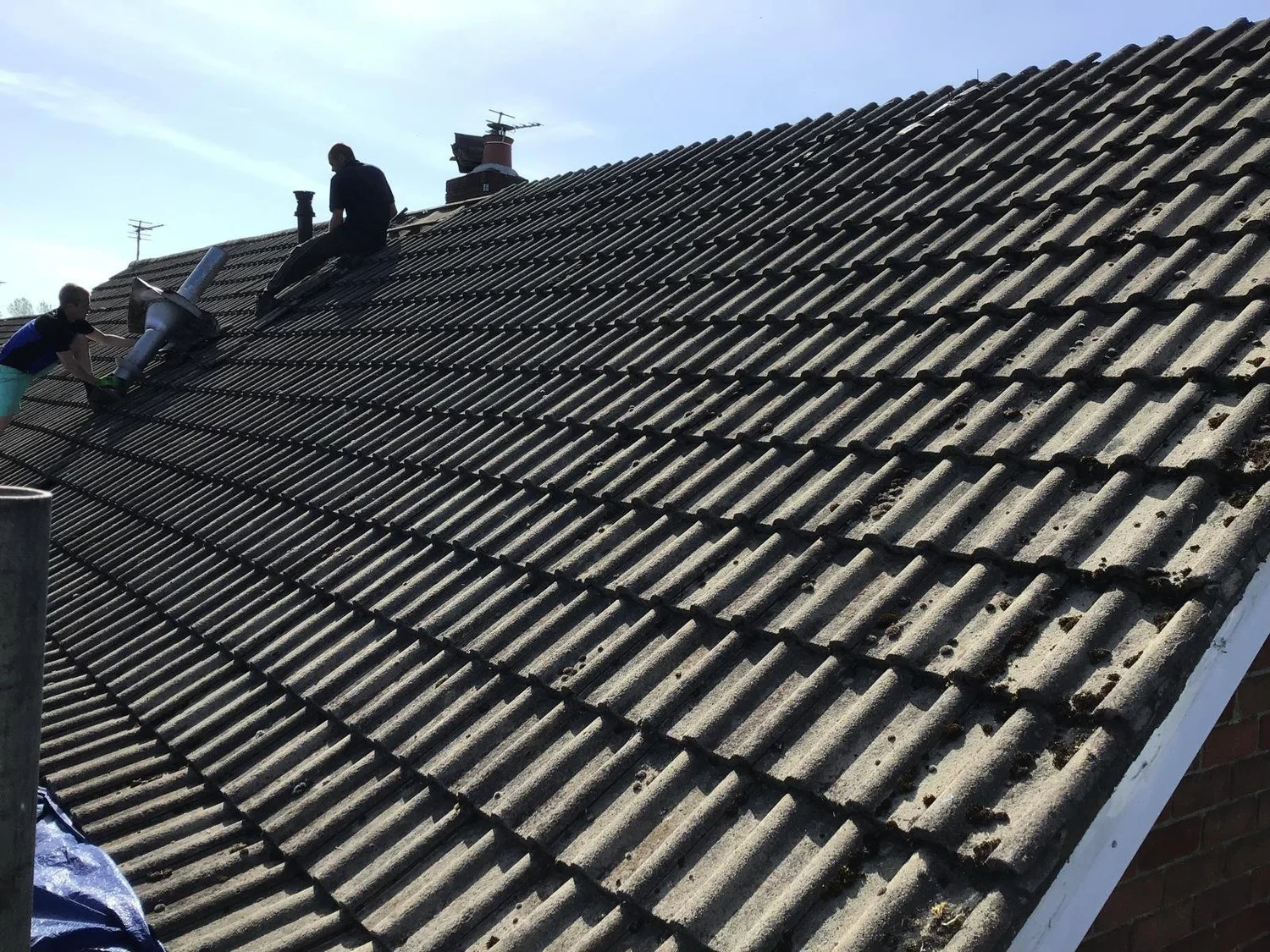
Here is what moss does, when it genuinely needs removing, what it costs, and why the cheap approach usually ends up being the expensive one.
01/What moss actually does to a roof
Holds moisture
A moss mat acts like a sponge, keeping the covering permanently damp instead of letting it dry between showers.
Accelerates freeze-thaw
That trapped water freezes, expands and works away at the surface of concrete tiles and older slate every winter.
Lifts tiles and slates
As it thickens under the overlap, moss physically pushes the covering apart and breaks the weathertight seal.
Blocks gutters and downpipes
Clumps break away, wash down and pack into the outlets — the single most common cause of overflowing gutters we see.
Hides real problems
A heavy moss layer conceals slipped slates, hairline cracks and failing mortar until water is already inside.
What moss does not do is cause a leak on its own overnight. If water is already coming in, the moss is a symptom sitting alongside the real fault, and you need roof repairs rather than a clean.
Why north-facing roofs are worst
Moss needs damp and shade. North-facing pitches get neither much direct sun nor much drying wind, so they stay wet for longer after every shower. Add overhanging trees and you have ideal growing conditions.
This is why so many Newcastle and Gosforth properties have one clean pitch and one green one. It is not a defect in the roof — it is aspect.
03/What roof moss removal costs
| Property | What's involved | Typical cost |
|---|---|---|
| Terraced house | Scrape, clear gutters, biocide treatment | £350 – £600 |
| Semi-detached | Scrape, clear gutters, biocide treatment | £450 – £850 |
| Detached | Scrape, clear gutters, biocide treatment | £650 – £1,200 |
| Bungalow | Larger roof area, easier access | £550 – £1,000 |
| Scaffold (if needed) | Access for steep or high roofs | £600 – £1,500 |
Most jobs are done from a roof ladder or tower. Scaffold is only needed on steep pitches, three-storey properties or where access is restricted — a proper quote will tell you which applies before you commit.
04/The three methods, and which one to avoid
Manual scraping
The standard approachMoss removed by hand with a scraper, then gutters cleared. Slow, but no water is forced under the covering and no pressure hits the tile surface. This is what we do on the vast majority of roofs.
Biocide treatment
Best used after scrapingA chemical wash kills off remaining spores so regrowth is much slower. It works gradually rather than instantly — expect the roof to keep clearing over several months.
Pressure washing
Avoid on most roofsFast and dramatic-looking, and the reason a lot of roofs end up needing work. High-pressure water strips the protective surface off concrete tiles and drives water under slates and up into the roof space.
If a company leads with jet washing and a suspiciously low price, that is your cue to get another quote. We have re-bedded ridge tiles and replaced slates on plenty of roofs where the only prior work was a pressure wash.
Should you do it yourself?
Honestly, usually not. The moss removal itself is not technical — the risk is entirely in the access. Roof ladders, wet slates and a two-storey drop are how people get seriously hurt, and a slate cracked underfoot costs more to put right than the job saved.
If your roof is a single-storey extension or a low garage you can reach safely from a stable ladder, scraping it yourself is reasonable. Work downwards, never upwards, and clear the gutters afterwards. Anything higher or steeper is not worth it.
06/When is the best time to do it?
Late spring through early autumn. The roof is dry, biocide treatments work better in mild weather, and you get the moss off before autumn leaf fall and winter rain combine to block your gutters.
Booking it alongside gutter cleaning makes sense too, because everything scraped off the roof has to come out of the gutters anyway.
07/How to slow the regrowth
- Cut back overhanging branches. More light and airflow means a drier roof.
- Keep gutters clear. Standing water at the eaves feeds growth along the bottom courses.
- Consider zinc or copper strips. Fitted near the ridge, these release trace metal ions in rainwater that inhibit growth down the pitch. Not a miracle fix, but they help.
- Re-treat every few years rather than letting it build back to a full mat.
Nothing stops moss permanently on a shaded North East roof. The realistic goal is keeping on top of it, not eliminating it.
08/When moss removal is not enough
Sometimes clearing the moss reveals the actual problem underneath. Watch for:
- Slates that are flaking or delaminating rather than just dirty
- Crumbling mortar along the ridge — usually a job for a dry ridge system
- Moss growing thickly around the chimney stack, which often points to failed flashings or pointing
- Sagging in the roof line, which is structural and needs surveying properly
If the covering is genuinely at the end of its life, cleaning it is money spent on a roof that needs replacing. Our guide to what a new roof costs covers how to tell the difference, and our slating and tiling page explains what a re-cover involves.
Getting it looked at
We survey the roof before quoting for moss removal, because on maybe one job in five the honest answer is that cleaning is not what the roof needs. You get told which of those you are looking at, in writing, before any work starts.
We cover Gosforth, Jesmond, Kenton, Heaton and across Newcastle and the North East. See examples of our recent work or read more about the company.